The four pillars · 03
Red light therapy. Actually works. We checked.
Not a bio-hack. Not a scam. Just LEDs at 630-850nm doing real work on your collagen — and you don't need to pay $250 a session at a medspa to get it.
Red light therapy is the one wellness trend of the last five years that actually has legs. The evidence is real. The devices are finally affordable. And unlike most skincare, you can't really overdo it.
Here's what you need to know to skip the scams and pick a device that works.
How red light therapy works
Your skin cells have tiny power plants called mitochondria. One of their enzymes — cytochrome c oxidase — absorbs specific wavelengths of red and near-infrared light super efficiently. When it does, cells make more ATP (energy), produce less oxidative damage, and fibroblasts start pumping out collagen like they're 25 again.
This is well-documented photobiology. The effect was first identified in 1967 in a Hungarian lab studying wound healing. It's not a fringe thing.
Wavelengths explained: 630 vs 660 vs 850nm
| Product | Depth | Best for | Rating | Where |
|---|---|---|---|---|
| Visible 630-660 nm (Red) | ~5mm | Fine lines, texture, tone, surface pigmentation | Daily | — |
| Invisible 810-850 nm (Near-IR) | ~10mm | Deep collagen, scars, firmness, inflammation | Daily | — |
| Visible 415 nm (Blue) | <1mm | Acne-causing bacteria (C. acnes) | Acne only | — |
What the research actually shows
Notable papers:
- Wunsch A, Matuschka K. "A controlled trial to determine the efficacy of red and near-infrared light treatment in patient satisfaction, reduction of fine lines, wrinkles, skin roughness, and intradermal collagen density increase." Photomed Laser Surg 2014.
- Avci P, et al. "Low-level laser (light) therapy (LLLT) in skin: stimulating, healing, restoring." Semin Cutan Med Surg 2013.
Our red light device picks
- Editor's pick MitoGLOW mask (5% off)
- Runner-up Omnilux Contour Face
- Best value Hooga HG300 panel
- Best splurge CurrentBody Series 2
- Best travel Solawave Wand
GlowNoFilter has a paid partnership with Mito Red Light (the MitoGLOW mask). We feature it because it's the rare at-home mask with FDA clearance for both wrinkles and mild-to-moderate facial acne — but the ranking and the words are our own. Use code GLOWNOFILTER for 5% off (or just click our link — it's applied automatically); we earn a commission at no extra cost to you.
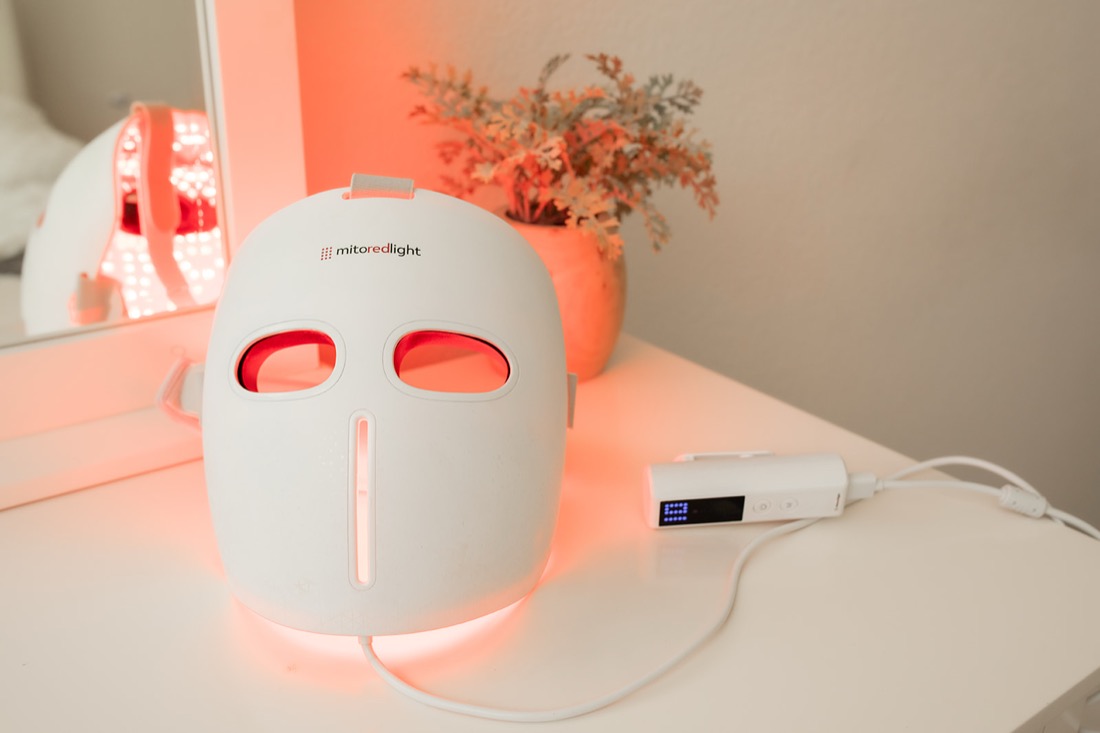 Paid partner
Mito Red Light
MitoGLOW LED Mask
1,064 LEDs · 4 wavelengths (465/590/633/830nm) · dual FDA 510(k).
Best for: Acne + anti-aging in one mask, hands-free
5% off with code GLOWNOFILTER — auto-applied via our link.
Sponsored placement — our take is our own.
Omnilux
Contour Face LED Mask
Flexible medical-grade silicone. 633nm + 830nm.
Best for: Anti-aging, hyperpigmentation, daily use
CurrentBody
Skin LED Light Therapy Mask Series 2
236 LEDs. Red 633nm + NIR 830nm. Flexible fit.
Best for: Fine lines, firmness, 10-minute routine
Dr. Dennis Gross
DRx SpectraLite FaceWare Pro
Rigid shell. 100 red + 62 blue LEDs. Sephora's bestseller.
Best for: Combo anti-aging + acne
Therabody
TheraFace PRO
Red light + microcurrent + percussive + cleansing. Sci-fi gadget.
Best for: Multi-tool users, tech-forward routines
Solawave
Solawave 4-in-1 Wand
Red light + microcurrent + therapeutic warmth + massage.
Best for: Travel, under-eye area, spot treatment
Hooga
HG300 Red Light Therapy Panel
Budget panel. 660nm + 850nm. Desk-mountable.
Best for: Whole-face + neck treatment, budget
Mito Red Light
MitoMIN 2.0
Targeted panel. 660/850nm. Stand or hang.
Best for: Face + neck, small spaces
✦If a device costs less than $80, is rigid, and doesn't list specific wavelengths, skip it. The market is full of useless LED clones.
Mask vs panel — which to buy
The honest answer: compliance matters more than irradiance. A mask you wear 5 days a week beats a panel you use once a month. Start with a mask.
How to use red light therapy for best results
- Cleanse. Dry skin.
- No serums, no actives, no moisturizer before the session.
- 10-20 minutes, 3-5 days per week.
- After: apply tretinoin (at night) or moisturizer + SPF (morning).
Frequently asked
Does red light therapy actually work? +
Yes — 50+ randomized controlled trials show measurable improvements in collagen density, fine lines, and wound healing with consistent use of 630-850nm wavelengths.
How long until I see results from red light therapy? +
Most studies show visible results at 8-12 weeks of 3-5 sessions per week. Collagen remodeling takes longer — 4-6 months for full effect.
How often should I use a red light mask? +
Most FDA-cleared masks are designed for daily 10-minute sessions. Five sessions per week is the evidence-based minimum.
Is red light therapy safe for your eyes? +
The red light wavelengths themselves are safe, but LED brightness can cause retinal strain. Close your eyes during use or use a mask with eye protection.
Red light mask vs panel — which should I buy? +
Masks are more convenient and hands-free. Panels deliver higher irradiance and treat larger areas (face + neck + chest). Power users get both; most people just need a mask.
Premium Beauty
The premium end of red light
FDA-cleared masks and highly rated Premium Beauty devices — we only rank the ones with real clinical evidence behind them.
SkinMedica
$295TNS Advanced+ Serum
Dual-chamber growth factor + peptide serum. Actually worth the splurge.
Buy on Amazon →SkinCeuticals
$182C E Ferulic Vitamin C Serum
15% L-ascorbic + 1% vitamin E + 0.5% ferulic. The gold standard.
Buy on Amazon →SkinCeuticals
$182Phloretin CF Antioxidant Serum
For oilier skin — phloretin + vitamin C + ferulic acid combo.
Buy on Amazon →Augustinus Bader
$290The Cream
TFC8 tech. The one celebrities keep talking about.
Buy on Amazon →EltaMD
$41UV Clear Broad-Spectrum SPF 46
The derm favorite. Zinc + niacinamide, no white cast.
Buy on Amazon →Supergoop!
$38Unseen Sunscreen SPF 40
Goes on like a primer. Zero white cast, zero scent.
Buy on Amazon →